
Something shifted quietly over the past year. The slog of data science (cleaning CSVs, writing boilerplate SQL, tuning hyperparameters) is now handled by AI. Coding agents have absorbed the grunt work that once defined entry-level data roles. If you spent two years perfecting your pandas wrangling or memorizing scikit-learn pipelines, you have good reason to pause and ask: what exactly is my value now?
The honest answer is that your value hasn’t disappeared. It’s moved. The data scientist’s role has shifted from model builder to system orchestrator. Autonomous agents and advanced large language models (LLMs) have automated most of the boilerplate coding, data cleaning, and basic statistical testing. The math of data science hasn’t changed, but the interface has.
That’s both uncomfortable and liberating. Uncomfortable because the skills you built your early career on are depreciating faster than expected. Liberating because the skills that remain, the ones agents genuinely can’t replicate, happen to be the most intellectually engaging parts of the work. What follows is a clear, honest strategy for staying indispensable as that transition accelerates.
Contents
- Understanding What Agents Actually Do (and Can’t Do)
- Step 1: Become a Skilled Agent Orchestrator
- Step 2: Deepen Your Domain Expertise
- Step 3: Develop Statistical and Scientific Skepticism
- Step 4: Invest in Communication and Business Storytelling
- Step 5: Build Responsible AI and Governance Fluency
- Step 6: Position Yourself for Hybrid and Strategic Roles
- Recommended Learning Resources
- Final Thoughts
Understanding What Agents Actually Do (and Can’t Do)
Before you can future-proof your career, you need an accurate picture of what you’re up against.
AI coding agents can automate data science tasks like feature engineering and hyperparameter optimization. Think of an agent as a tool that significantly augments your work, automating manual tasks for a substantial productivity gain. That’s the case in its favor. Here’s where it breaks down.
Coding agents excel at code but struggle with data science skepticism. They tend to celebrate early successes without flagging potential data quality issues, a gap that distinguishes pure coding assistance from actual data science. An agent will generate a model. It won’t question whether the target variable was defined correctly, whether the training data reflects the population you care about, or whether the business actually needs a model at all.
Despite everything LLMs and AI agents can do, a fundamental question remains: to what extent do human experts outperform autonomous AI agents on domain-specific data science tasks? In practice, the answer is quite a bit. In the most effective workflows, humans guide the problem-solving process while AI accelerates coding, experimentation, and iteration.
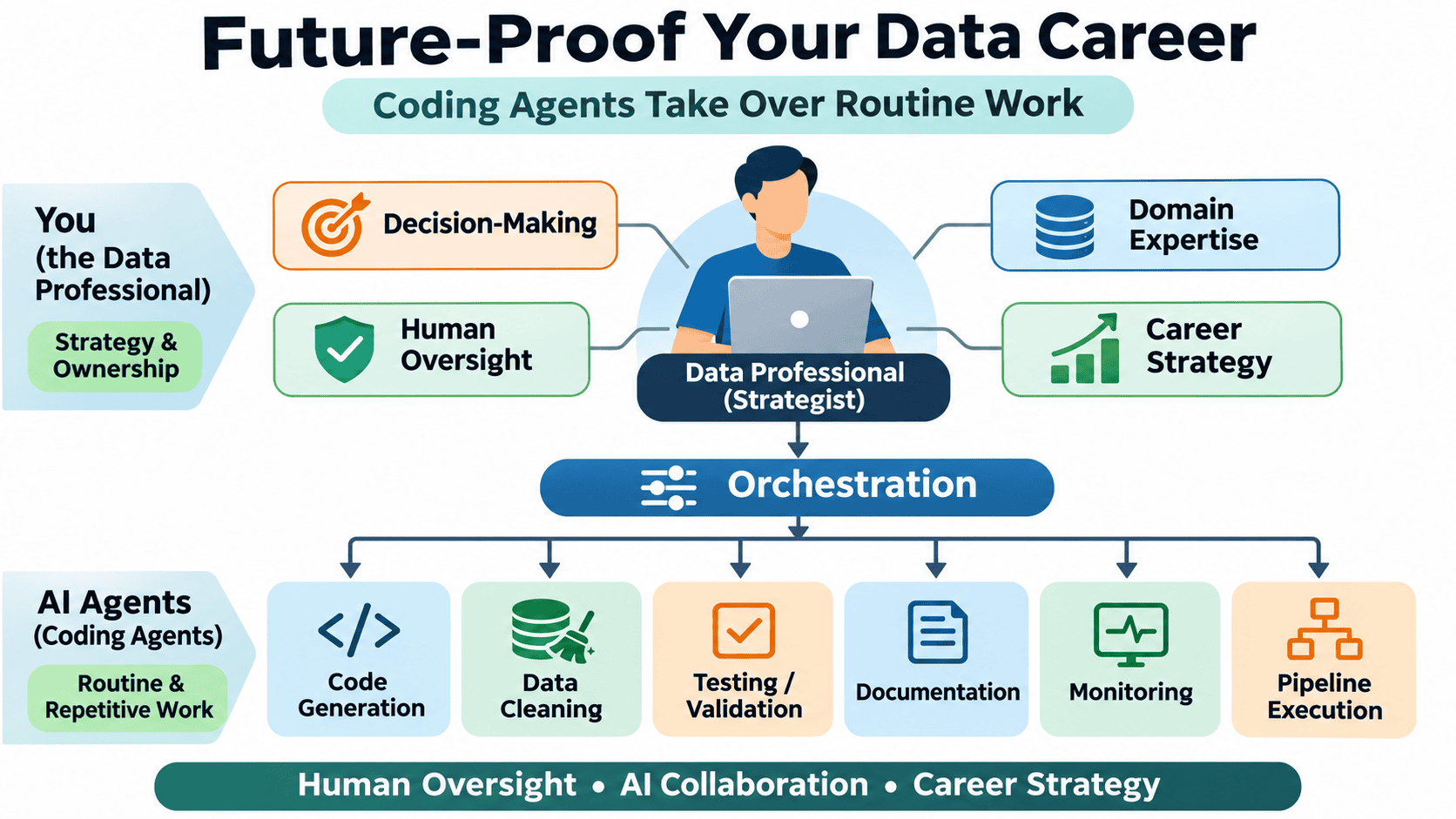
The model can write the code. It can’t own the decision. That distinction is about to define the entire future of data science, and it’s your career strategy. Every section below is a direct response to something agents do poorly or can’t do at all.
Step 1: Become a Skilled Agent Orchestrator
The most immediate shift you need to make is treating coding agents as colleagues you manage rather than tools you use.
We’re in a new era of building agents. The data scientist’s role is being promoted from specialized coder to high-level strategic architect. In practice, that means learning how to structure problems in ways agents can execute reliably, how to verify their outputs, and when to override their suggestions.
Here’s what a well-designed agentic workflow actually looks like. You handle problem definition and meet with stakeholders to understand the business need. Specialized agents then work in parallel, handling data preparation, analysis, and initial modeling, logging their progress, flagging issues, and storing results. By automating the repetitive technical tasks, agents free you to focus on asking the right questions, finding new solutions, and driving real business impact.
This isn’t a passive upgrade. Learning to write precise, verifiable prompts for agents, design multi-step pipelines, and audit agent outputs critically is a genuine skill that takes time to develop. The practitioners who do it well will operate at dramatically higher leverage than those who don’t.
Resources for building this competency:
Step 2: Deepen Your Domain Expertise
This is the step most technical practitioners underestimate, and the one that offers the most durable protection.
Domain expertise ensures data science gets applied in the right context. Understanding industry-specific metrics, regulations, and processes is what allows you to generate insights that actually matter. Combining domain knowledge with technical skills ensures your models are relevant, interpretable, and aligned with actual business objectives.
Agents have no industry context. They don’t know that a churn model in telecommunications needs to account for seasonal contract renewals, that a fraud detection model in healthcare must comply with HIPAA constraints, or that the metric a marketing team has been optimizing for three years is a proxy for something else entirely. You can develop that understanding. Agents can’t.
The ability to help business leaders answer key questions, and even help them figure out which questions need answering in the first place, requires domain understanding that the model simply doesn’t have.
A professional with deep expertise in a specific vertical, whether that’s fintech, clinical research, supply chain, or digital media, is genuinely difficult to replace. The agent has no way to acquire that contextual knowledge on its own.
Resources for building domain depth:
- O’Reilly’s industry-specific data science books cover domains from healthcare to finance to e-commerce with technical rigor.
- Industry newsletters and journals in your chosen vertical are underrated. Reading what practitioners care about, which metrics matter and which regulations are shifting, compounds into a real advantage over time.
- Coursera’s industry specializations offer structured domain-focused credentials in areas like healthcare data science and financial technology.
Step 3: Develop Statistical and Scientific Skepticism
One of the clearest failure modes in an agent-augmented workflow: the agent produces output that looks correct. The numbers are plausible. The visualizations are clean. The model accuracy is respectable. And the entire thing is built on a flawed premise nobody caught.
This is where statistical thinking becomes your most distinctive asset.
Automation and AI handle repetitive tasks well, but they can’t replace the critical thinking, domain knowledge, and creativity you bring. In a technical context, critical thinking means looking at a model’s output and asking: does this make sense given what I know about causality here? Are there confounders? Is the evaluation metric aligned with the actual business outcome? Could this finding be a data artifact rather than a real signal?
Agents pass through these questions without pausing. Experienced data scientists catch them. That gap in skepticism and scientific judgment is exactly what separates a dataset that produced a decision from a dataset that produced a costly mistake.
Resources for strengthening statistical reasoning:
Step 4: Invest in Communication and Business Storytelling
The job title is the same, but the work isn’t. Orchestrating agents and designing guardrails have replaced executing every step by hand.
What hasn’t changed is the fundamental requirement to translate technical findings into decisions. Being a data scientist goes beyond writing accurate models. Clear communication, collaboration, and basic business acumen are what support and contextualize all the technical work.
This matters more now, not less. As agents absorb the execution layer, the differentiating work becomes framing problems clearly for agents on one end and translating agent outputs into business decisions on the other. Both require communication skill. Neither agents nor executives can close that gap for you.
Numbers alone don’t move decisions. You need to translate findings into charts, dashboards, and a narrative that stakeholders can actually act on.
The data scientist who can sit in a strategy meeting, understand what a business leader is actually worried about, and return with a clear analytical answer delivered in terms the room understands: that person isn’t getting replaced by an agent anytime soon.
Resources for building communication skills:
Step 5: Build Responsible AI and Governance Fluency
As data science becomes more tightly linked with AI, you need skills that go beyond programming and analytics. Understanding responsible AI use, data governance, and human oversight is no longer optional.
Organizations deploying agents at scale are running into questions they weren’t prepared for. Who’s accountable when an agent-generated model produces a biased outcome? How do you audit a pipeline that ran autonomously? What does explainability mean when the analysis was generated rather than hand-crafted?
These are governance and ethics questions, and they require human judgment. The data professional who understands how to build appropriate guardrails, evaluate model fairness across demographic groups, and design audit trails for agentic workflows is in a position that’s structurally protected from automation.
Data scientists will play a key role in addressing ethical concerns related to AI and ensuring fairness in AI-driven decision-making, and organizations are starting to realize they need people who can actually do that work.
This isn’t about becoming a compliance officer. It’s about understanding enough of the governance layer to be a credible voice in conversations about how your organization deploys AI responsibly.
Resources for building responsible AI fluency:
- Google’s People + AI Research (PAIR) Guidebook provides practical frameworks for thinking about human-centered AI design and responsible deployment.
- The Alan Turing Institute’s AI Ethics resources cover fairness, transparency, and accountability with both academic depth and practical applicability.
- Fairlearn, an open-source toolkit from Microsoft, is worth knowing both technically and conceptually. Running fairness assessments and interpreting the results is a concrete skill that hiring managers are increasingly looking for.
Step 6: Position Yourself for Hybrid and Strategic Roles
The boundaries between data science, AI, analytics, and data engineering are blurring. Future roles will combine expertise across machine learning, generative AI, and domain-specific applications. Technical depth alone won’t be enough; you’ll need the business understanding to match.
The emerging premium in the job market isn’t for specialists who go deeper into execution. It’s for professionals who can span domains: someone who understands the full pipeline from data infrastructure to business strategy, who can communicate with engineering teams and C-suite stakeholders, and who can make sound judgments about where agents should and shouldn’t be trusted.
Strong stakeholder communication and business problem-solving are among the most valued attributes in data scientist job postings, alongside experience with large-scale data processing and analytics.
This doesn’t mean abandoning technical depth. It means layering strategic and communicative capacity on top of it. The professionals who do both well become the connective tissue in organizations navigating an agentic transition, and that’s an extremely difficult position to commoditize.
Resources for developing strategic capability:
Recommended Learning Resources
For building a future-proof development plan, these are worth bookmarking:
- DeepLearning.AI for structured short courses on agentic AI and LLM applications
- Coursera’s data science specializations for domain-specific credentials
- StatQuest with Josh Starmer for statistical intuition
- Storytelling with Data for communication skills
- Google’s PAIR Guidebook for responsible AI frameworks
- Towards Data Science for staying current on how the field is evolving
Final Thoughts
The practitioners who’ll thrive aren’t necessarily the ones who code the least or the most. They’re the ones who understand clearly what agents are good at, design workflows that use them well, and invest in the capabilities that remain stubbornly human: judgment, context, skepticism, communication, and accountability.
Teams that adapt their workflows and upskill their members will capture the competitive advantage that coding agents offer. The shift is happening whether you lean into it or not. The professionals who treat this moment as an invitation to operate at a higher level, rather than a threat to defend against, will find that their careers become more interesting, not less.
The agent can write the code. You bring everything else.
Vinod Chugani is an AI and data science educator who bridges the gap between emerging AI technologies and practical application for working professionals. His focus areas include agentic AI, machine learning applications, and automation workflows. Through his work as a technical mentor and instructor, Vinod has supported data professionals through skill development and career transitions. He brings analytical expertise from quantitative finance to his hands-on teaching approach. His content emphasizes actionable strategies and frameworks that professionals can apply immediately.