
Author name: aifuturethinkers.com

Hello, and welcome to the world of my AI! I am overjoyed that you have chosen to accompany us on this journey into the fascinating field of artificial intelligence. If you find artificial intelligence to be as fascinating as I do, you are in for a thrilling trip! As a Data Engineering professional, I’ve been immersed in technology for the past ten years, and it’s become second nature to me. With a Master’s degree in Computer Application under my belt, I’ve had the fortunate opportunity to see artificial intelligence (AI) disrupting businesses and changing the game in ways that we couldn’t have anticipated before it happened. Now that I’ve finished reading all of my blogs, I’m ready to pass on all of the incredible information that I’ve gained. Together, we will investigate everything from the most cutting-edge AI applications to the most recent fashions. It doesn’t matter if you’ve never worked with AI before; I guarantee to make the process easy and entertaining so that anybody may take part in the AI adventure.

MulticollinearityPhoto

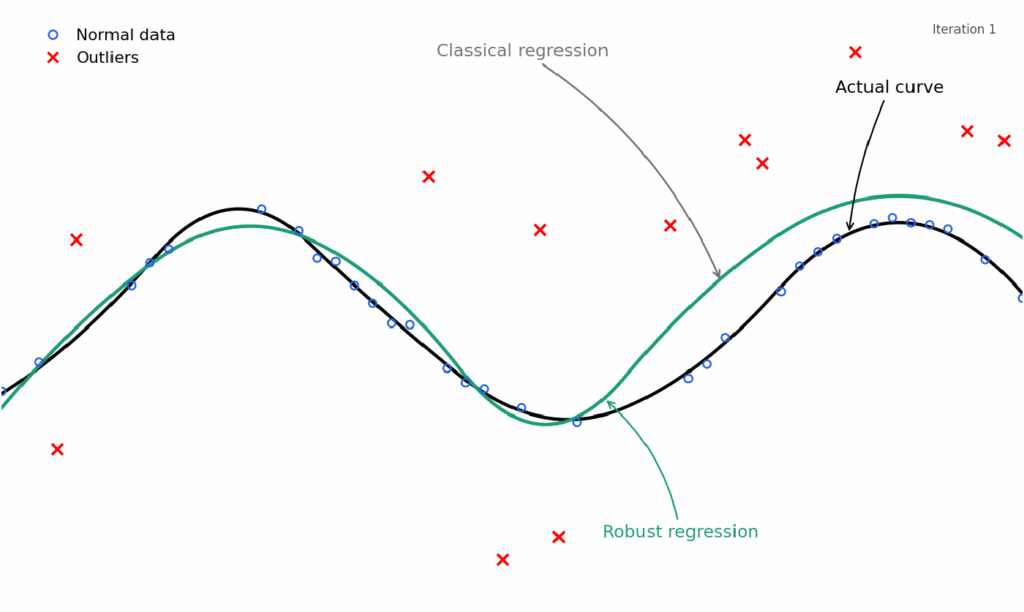
Why Your Betas Explode: The Hidden Geometry of Multicollinearity

a marketing mix model to a senior director. The slide showed two beta coefficients side by side: Linear TV at +2.4, Digital TV at +1.8. He nodded, satisfied. Then he asked the question I was dreading. “Let’s assume we run this with last week’s refreshed data. Same channels, same model, same everything, but one extra …

Why Your Betas Explode: The Hidden Geometry of Multicollinearity Read More »

D1F0F3B0 AFD2 4DA5 B3D6 899AB1A9708C

Pydantic + OpenAI: The Cleanest Way to Get Structured Outputs from LLMs

In my latest post on structured outputs, the three main approaches for getting machine-readable responses from an LLM. Those are JSON Mode, Function Calling, and OpenAI’s Structured Outputs. If you haven’t read that post yet, it’s worth a quick read before this one, since we’ll be building directly on top of it. So, today, we’ll …

Pydantic + OpenAI: The Cleanest Way to Get Structured Outputs from LLMs Read More »

awan 5 realworld sql projects build data portfolio 1

5 Real-World SQL Projects to Build Your Data Portfolio

  # Introduction  SQL is still one of the most important skills for data analysts, data scientists, business intelligence analysts, and analytics engineers. But learning SQL syntax is only the first step. To stand out, you need to show that you can use SQL to solve real business problems. That is where portfolio projects help. A …

5 Real-World SQL Projects to Build Your Data Portfolio Read More »

Pruning prompts into AI flow

Long Context Isn’t Free — I Built a Safe Prompt-Pruning Layer That Makes LLM Systems Work

I’ve worked on, conversation state tends to grow quickly over time. It’s common to resend large portions of the history on each turn—including older tool outputs, repeated RAG retrievals, and context that’s no longer relevant. As this accumulates, prompts can become significantly larger, which may increase inference cost and latency, and in some cases affect …

Long Context Isn’t Free — I Built a Safe Prompt-Pruning Layer That Makes LLM Systems Work Read More »

Noob Series Fine Tuning Explained

Fine-Tuning Explained for Noobs (How Pretrained Models Learn New Skills)

  # Inroduction  This article is part of my noob series where we write about the questions people Google most but may not understand well because of complex math and everything. So, if you are here, you might have heard fine-tuning somewhere in the context of large language models (LLMs) especially. This concept already existed in …

Fine-Tuning Explained for Noobs (How Pretrained Models Learn New Skills) Read More »

kdn 7 steps to automating descriptive statistics with python feature

7 Steps to Automating Descriptive Statistics with Python

  # Introduction  Every analysis starts the same way: you load a dataset and try to figure out what’s actually in it. How many rows? Which columns are numeric? How much is missing? Is anything wildly skewed? Most of us answer those questions by copy-pasting the same df.describe(), df.isna().sum(), and df.groupby(…).agg(…) snippets we’ve typed a thousand …

7 Steps to Automating Descriptive Statistics with Python Read More »

Scroll to Top