
A modern chip has about a hundred billion transistors, all running at the same time. The thing that keeps them coherent is not their independence. It is the moment, one billion times a second, when every one of them pauses and steps forward together.
How do AI chips work, and why is the pause the part that matters?
How AI chips work depends on the pause. The pause is where the actual computation lives. The clock pulse is the announcement, not the work. AI chips win by making the pause longer and more predictable, not by making the clock faster than the silicon allows.
Contents
A chip is not a swarm#
Picture a hundred billion transistors on a chip. Now picture them all freezing at the same instant, one billion times a second, then taking one tiny step forward together. That moment of freezing is what a clock cycle is.
It is also, in a way that almost nobody explains, the whole reason the chip works.
Without the freeze, the parts of the chip would finish their work at slightly different times. The answers would not line up. The math would come apart.
Parallel computing is not many things happening independently. It is many things happening at the same beat. The beat is the work.
When many things are doing work at the same time, the results have to meet somewhere. The clock is the moment they meet.
Moving forward in lockstep is what makes it work. Every transistor steps at the same moment, the way a sound stays clean only when every part lands on the same beat. The downbeat is the cycle.
At the clock instant, whatever value happens to be on each wire gets stored in that wire’s register. The chip steps forward one beat. The wires reset. The next computation begins. The cycle repeats a billion times a second.
A chip is not a swarm of independent parts. Every nanosecond, every transistor pauses and steps forward together. The pause is the work.
Read the gigahertz number on a chip’s specification sheet as a count, not a speed rating. It is the number of pauses per second. A faster chip is a chip that pauses more often.
The slowest part sets the pace#
Now comes the next question: what sets its speed.
The answer is unexpected.
Clock speed is not set by a chip’s fastest part. It is set by its slowest. Whatever takes the longest to finish in a single cycle determines how fast the whole chip can run.
This is true for the same reason a convoy on a mountain road moves at the speed of the slowest truck. The fastest truck in the line cannot pull ahead of the slowest one without losing the convoy. The clock is the convoy. The slowest piece of logic is the slowest truck.
For decades, the standard fix was to split a long logic path in half with a register in the middle. The clock could then run twice as fast, at the cost of one extra register. This is called pipelining. It worked for thirty years.
Then the fix stops working. Some logic cannot be split that way. A calculation that feeds its result back into itself, a running sum or an accumulator, breaks if you put a register in the middle of the loop. The loop has to finish in one cycle. Whatever the slowest loop takes is what the whole chip can do.
That is why two chips built on the same manufacturing process can end up at different clock speeds. One has a tighter feedback loop than the other. The chip with the tighter loop runs faster. The chip with the looser loop runs slower. Same factory. Same materials. Different speed limit.
It is also why the era of doubling the clock every few years ended. The slowest feedback loop stopped cooperating. Designers turned to other strategies, more cores, smarter caches, specialized circuits, because the clock could not be pushed past the loop.
In any parallel system, the slowest piece sets the pace. The chip is the cleanest example. The same rule shows up in any workshop where many hands meet a deadline, any kitchen with five cooks waiting on one oven, any household trying to leave on time when one parent is still tying a shoe.
The slowest part runs the meeting.
There is no free move#
Every choice on the timing side of a chip costs something.
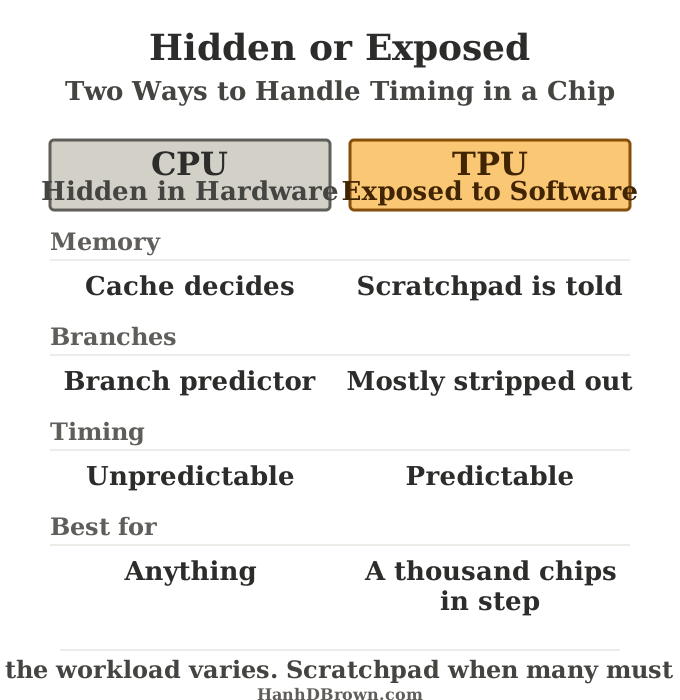
A faster clock costs more power. A deeper pipeline costs more registers and more silicon area. A bigger cache costs predictability. A scratchpad costs programmer time. There is no free move.
Matching the cost to the work is the whole trick. A laptop runs a thousand different programs in a day. The CPU pays the cache cost because the average-case speed is what the user feels. A training cluster runs one workload for weeks. The TPU pays the scratchpad cost because the coordination cost across a thousand chips is what the operator feels.
One rule sits under all of it. Coordination has a cost. The cost lives somewhere.
The clock pulse is the cost made visible. The pause every nanosecond is the toll the chip pays to keep a hundred billion transistors moving in the same direction. The faster the chip wants to go, the more often it has to pay the toll, and the harder it gets to keep paying.
Anyone who has tried to coordinate a Thanksgiving dinner with eight family members in one kitchen knows the rule from the inside. The turkey is the slowest dish. The turkey sets the pace.
Push past the turkey and you end up with cold sides and a half-raw bird. The chip designer who tries to push past the slowest feedback loop ends up with a chip that does not work.
Once you can see the clock pulse, you read every AI chip announcement through a different lens. Clock speed is the toll rate. The slowest part of the chip sets the rate. Cache versus scratchpad is the choice about who pays in time, the hardware or the programmer. None of it is free.
So a chip is not a swarm. It is a hundred billion transistors that pause together. The price of getting that many things to work at once is that, every nanosecond, they all have to stop and look at each other.
A chip is a hundred billion transistors pausing together a billion times a second. A reader holding the next chip announcement now has a frame for what the gigahertz number means and why the AI chip looks different from the laptop chip on the same desk.
The pause is the work. The slowest part sets the pace. The next time a child asks how a chip clock works, the answer is one sentence long.
The argument draws on Reiner Pope’s podcast interview with Dwarkesh Patel, 2025.
Source: Reiner Pope, in a talk on chip design, “Chip design from the bottom up.”
···